Reduce evaporator steam demand by reusing process-vapor heat.
Mechanical vapor recompression recovers heat from evaporation and puts it back to work, reducing dependence on fresh steam for concentration and industrial water-removal duties.
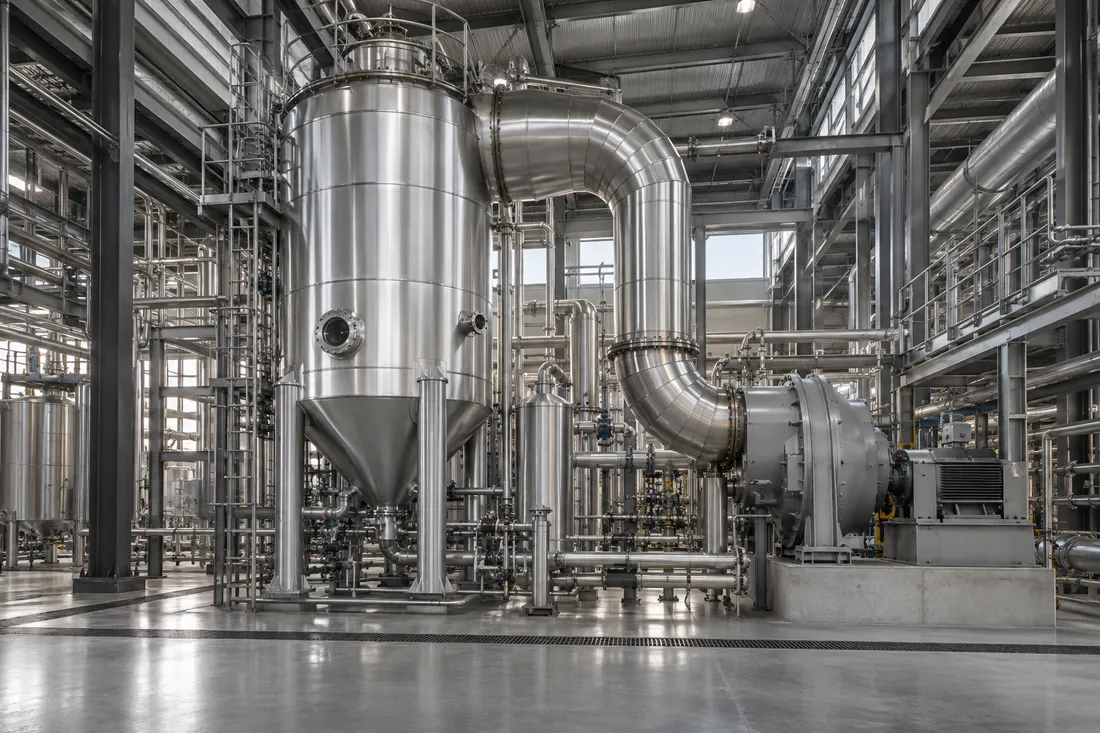
Single-use evaporation heat keeps the steam bill high.
When vapor heat leaves the process unused, fresh steam must keep replacing it. High evaporation volumes turn that repeated heating duty into a major operating expense.
High fresh-steam consumption
Every production run repeats the thermal load needed to remove water.
Utility cost tied to production volume
More concentration duty can mean a larger steam bill at the same process efficiency.
Aging evaporation equipment
Fouling, cleaning and maintenance can reduce availability as well as increase running cost.
Recover vapor heat instead of supplying the same heat once more.
MVR compresses suitable process vapor to a higher pressure and temperature so it can heat the evaporator again. RISEC coordinates retrofit or replacement scope around the required concentration, feed chemistry and production duty.
Recover process vapor
Capture vapor from evaporation and route it into the heat-reuse circuit.
Recompress for useful temperature
Use compressor work to raise vapor temperature for the heating duty.
Integrate heat exchange and controls
Coordinate evaporation, compression, heat transfer and production control.
Choose retrofit or replacement
Match the existing vessel, utilities and available site space to the proposed configuration.
Where you recover value.
Reduce purchased steam
Reuse heat already present in process vapor to displace fresh thermal input.
Lower water-removal cost
Compare the steam displaced with compressor electricity and routine operating expense.
Modernize process operation
Address control, cleanability and heat-transfer requirements as part of the same upgrade.
$20,000/year
An example $2 reduction in net operating cost per ton of water removed becomes $20,000 over 10,000 tons per year. Net cost includes compression electricity.
How the process works.
Feed stream
Feed the liquid stream into the evaporation system.
Evaporation
Remove water to reach the required concentration.
Vapor recovery
Collect vapor produced by the process.
Recompression
Compress the vapor to raise its useful temperature.
Heat reuse
Transfer recovered heat back into evaporation.
Concentrate
Discharge the concentrated product or residual stream.
Published research on vapor heat recovery
A 2021 Applied Thermal Engineering pilot study predicted 73.86% energy savings for its intermittent evaporation configuration against its specified single-effect comparison. A separate MVR-assisted vacuum membrane-distillation study reported 79.24% lower energy consumption than its non-MVR comparison. These are two different research configurations. Read the evaporation study or the membrane-distillation study.
Equipment scope and common questions.
Equipment selection covers evaporation load, boiling-point elevation, viscosity, solids, corrosion, scaling, compressor duty, cleanability and the available steam and electrical supply. Installation includes the relevant controls, heat-transfer changes and commissioning.
Can an existing evaporator be retrofitted?
Retrofit scope depends on vessel design, heat-transfer area, compressor integration, utilities and space. Replacement is an alternative when those changes are extensive.
Does MVR remove the need for all steam?
Start-up and some process conditions still need external heat.
Who supplies and commissions the system?
The proposal establishes responsibilities for engineering, equipment, installation, commissioning, service and warranties with the implementation provider.
Put process-vapor heat back to work in your evaporator.
Tell us about the operation you want to improve. We will help define the equipment, integration and next steps for that application.