Shorten the route from tool design to production-ready molds and patterns.
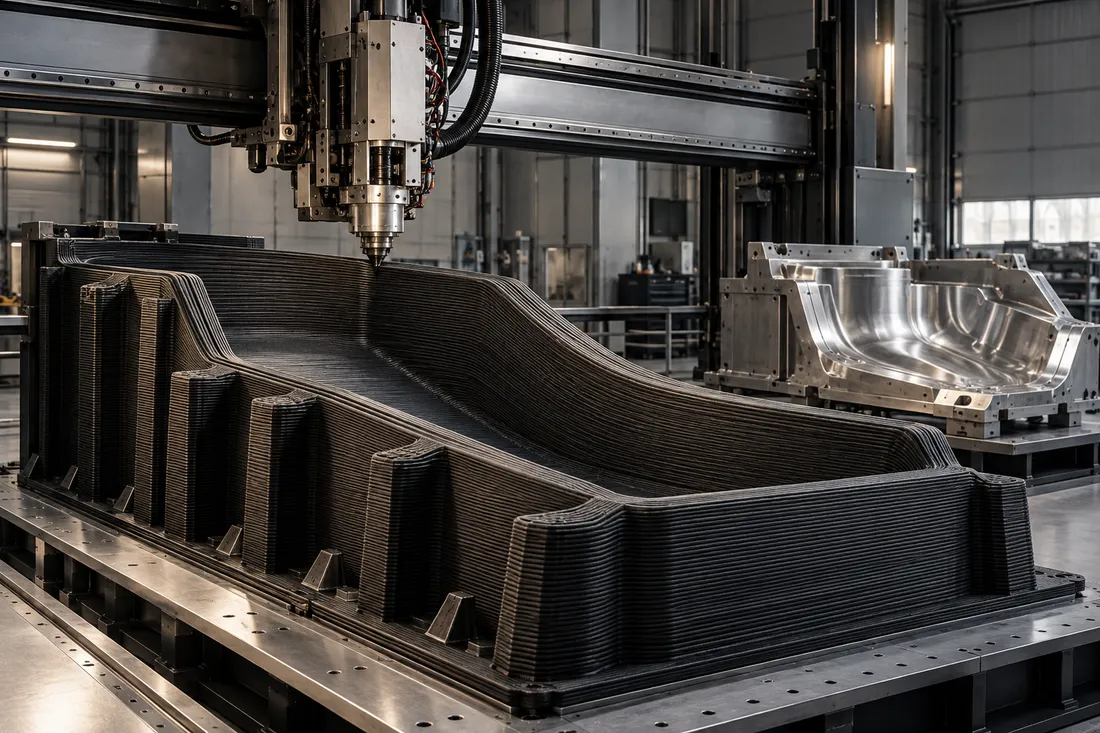
Build eligible large tooling near its final shape, then machine and finish the critical surfaces to reduce bulk material removal and tooling lead time.
Production waits while large tooling is procured and machined.
A large mold, pattern or fixture can consume a costly block of material and weeks of machining access. Design changes restart that route and leave production programs waiting for a tool.
Tooling delays the production program
The required mold or pattern sits on the critical path to the first part.
Bulk material is removed as waste
Traditional routes can spend substantial machining effort removing stock.
Design changes repeat tooling work
New geometry drives additional procurement, machining and setup.
Print near the required shape, then finish the working surfaces.
RISEC connects the tooling requirement to large-format additive manufacturing and the necessary machining, finishing and qualification. The scope covers a ready-to-use tool rather than an unfinished printed blank.
Select the tooling material
Match the build to temperature, pressure, loads and intended service life.
Build near-net geometry
Deposit material around the required tool form instead of removing a large block.
Machine and finish critical areas
Include precision surfaces, coatings, support and any required treatment.
Qualify the production tool
Check dimensions, stability, surface and the intended operating conditions.
Where you recover value.
Reduce tooling lead-time pressure
Shorten eligible build routes and reduce dependence on bulk machining.
Reduce removed material
Build near the form the tool needs to become.
Respond faster to geometry changes
Use an additive route for suitable revised molds, patterns and fixtures.
3 weeks earlier
An example tool route reduced from eight weeks to five reaches the required tool-delivery milestone three weeks earlier.
How the process works.
Tool requirement
Define the tool geometry and operating requirement.
Print blank
Print the near-net tooling blank.
Machine surfaces
Machine the precision surfaces.
Qualify
Qualify dimensions and production suitability.
Production use
Put the finished tool into service and maintain it.
Service life
Plan replacements against the required production life.
Large printed tooling in manufacturing
Oak Ridge National Laboratory describes large 3D-printed tooling and molds for manufacturing, including printed metal molds for automotive applications. Read the ORNL report.
Equipment scope and common questions.
The scope covers material, dimensions, temperature, pressure, tolerance, surface finish, support, treatment, machining, coatings, stability, useful cycles and replacement needs. Composite layup tooling, injection molds and structural fixtures have different requirements.
Is the printed tool ready to use immediately?
Precision surfaces, treatments or coatings may be needed after printing. These steps are included in the tooling route.
Can it replace every conventional mold?
The material, operating temperature, loads and required life determine the suitable applications.
Who approves the tool for production?
The project establishes the qualification and acceptance responsibilities for the intended manufacturing use.
Get the tool you need into production sooner.
Tell us about the operation you want to improve. We will help define the equipment, integration and next steps for that application.