Stop case packing from holding back your production line.
Automate counting, collating and loading products into cases to reduce repetitive packing labor and keep finished goods moving toward shipment.
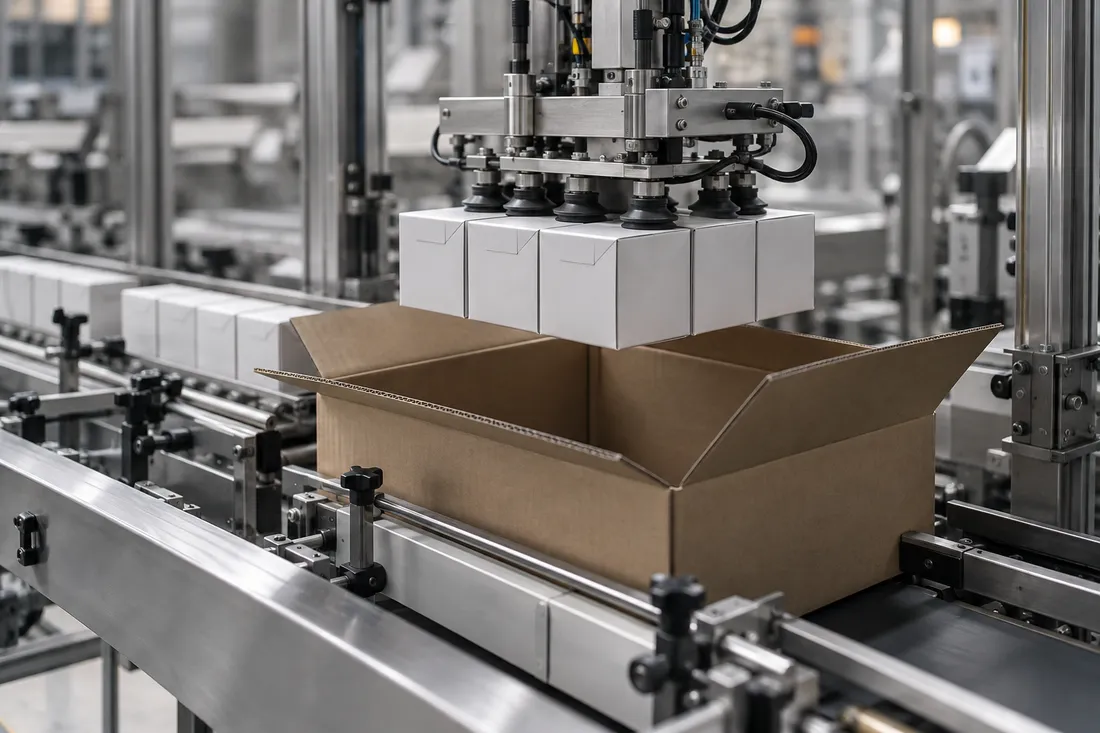
Production cannot ship faster than the packing station can clear it.
Products queue, operators add manual touches and upstream equipment can be forced to wait. Packing shortages turn available production capacity into work in progress instead of finished cases.
Upstream production gets blocked
A slower packing station limits the completed cases leaving the line.
Packing labor grows with volume
Counting, orienting and placing every item repeats throughout each shift.
Jams and changeovers interrupt flow
SKU changes and poor recovery reduce usable packing time.
Connect product arrivals to a repeatable packing sequence.
RISEC scopes robotic or conventional case packing around your products, case formats and line rate. The equipment brings collating, case presentation, loading, checks and the sealing handoff into one coordinated operation.
Collate and orient products
Build the required count and arrangement without repeated manual sorting.
Present the correct case
Coordinate case erection or presentation with product arrivals.
Load and protect the product
Match grippers, dividers and loading motion to the goods.
Coordinate the line handoff
Include checks, reject handling, sealing interfaces and changeover recipes.
Where you recover value.
Increase completed case flow
Remove a packing constraint that blocks upstream production.
Reduce repetitive pack labor
Automate counting, orientation and placement on the agreed SKUs.
Improve consistency across runs
Use defined pack patterns, recipes and fault-recovery routines.
6,000 units/shift
A packing constraint of 100 units per minute behind a line supplying 120 creates a 20-unit-per-minute gap. Over five running hours, that is 6,000 units waiting to be packed.
How the process works.
Unit arrival
Receive products from the upstream conveyor.
Collation
Collate the required count and orientation.
Present case
Present the case and any dividers.
Pack pattern
Load the agreed product pattern.
Seal and check
Transfer the loaded case into sealing and checking.
Finished cases
Discharge finished cases to the next operation.
Why line balance matters more than rated machine speed
Packaging-equipment guidance explains case-packer efficiency through line speed, available operating minutes and quality losses. These operating factors determine the finished cases a line actually produces. Read the efficiency explainer.
Equipment scope and common questions.
The scope covers product dimensions and fragility, packs per minute, case sizes, SKU changes, grippers, product protection, inspection, rejects, guarding, controls and service access. Palletizing is a separate operation that can be included alongside packing.
Can it handle several case sizes?
Specify the case formats and representative SKUs in the equipment scope, recipes and acceptance runs.
Does this include palletizing?
Palletizing stacks finished cases onto pallets. It is added as a separate linked function when required.
How do we confirm the line rate?
Run representative products, case patterns, changeovers and jam recovery against the required completed-case rate.
Keep packing capacity ahead of the work arriving from production.
Tell us about the operation you want to improve. We will help define the equipment, integration and next steps for that application.