Increase press-brake output without repeating every manual lift and turn.
Automate blank pickup, positioning, reorientation and stacking on repeatable bending work so operators can focus on setup, quality and the rest of the shop.
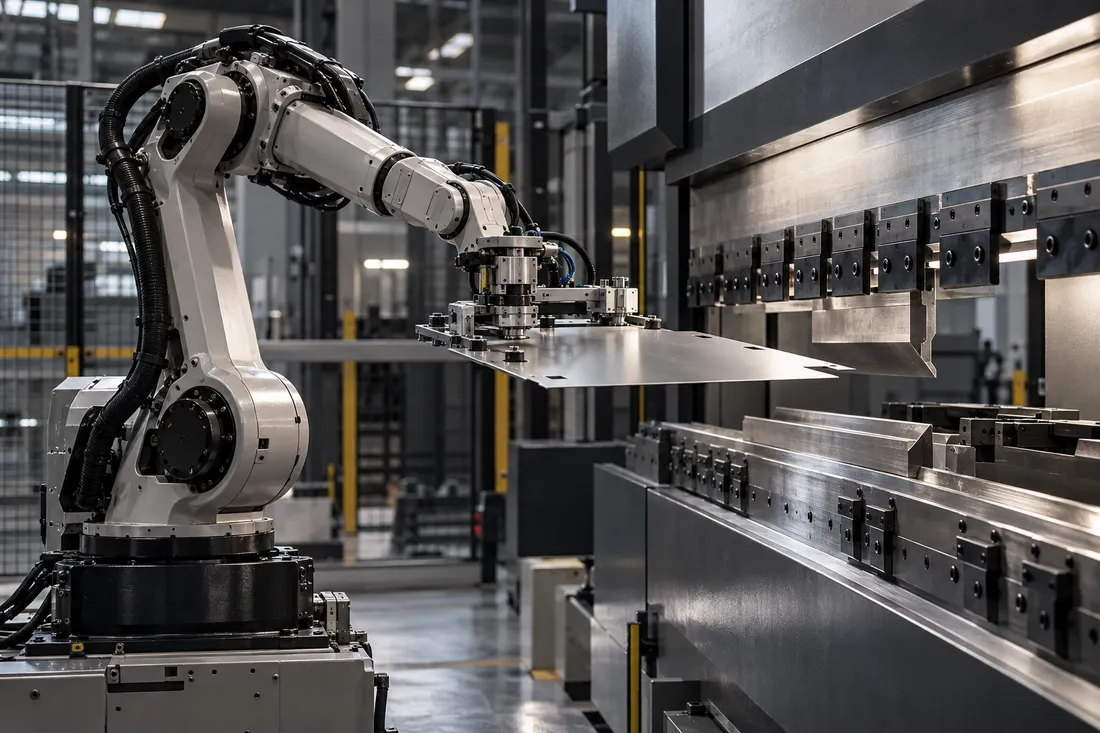
Bending capacity is lost between the bends.
Operators repeatedly lift blanks, position them, support the part, turn it and unload the result. When handling sets the pace, the brake waits and skilled people spend the shift repeating the same movements.
Handling dominates the cycle
Loading, repositioning and unloading keep the brake away from forming.
Skilled staff tied to repetition
Operators spend time moving parts instead of setup and inspection.
Inconsistent flow across shifts
Heavy parts and repeated regripping create difficult, labor-intensive work.
Build the tending sequence around the whole formed part.
RISEC groups recurring part families and scopes robotic pickup, bend presentation, regripping and unloading with suitable providers. The design includes the changing geometry after each bend and the changeover between jobs.
Pick and present blanks
Control the initial position and grip of the sheet.
Coordinate with the brake
Integrate the machine and back-gauge interfaces with the bend sequence.
Reorient between bends
Plan supported handling as the part shape changes.
Unload and change jobs
Include stacking, gripper or recipe changes and first-piece checks.
Where you recover value.
Increase brake utilization
Keep repeatable work moving through the forming sequence.
Reduce repetitive lifting
Transfer eligible blank and formed-part handling to the cell.
Release operator capacity
Use staff time for setup, inspection and jobs that need manual skill.
250 hours/year
Removing 30 seconds of manual handling from 30,000 parts releases 250 hours of handling time, before changeovers and remaining supervision.
How the process works.
Blank pickup
Pick the blank from its presentation position.
Position
Locate the sheet against the brake reference.
First bend
Complete the first bend.
Reorient
Reorient and regrip the changing part.
Following bends
Complete the remaining bend sequence.
Unload
Unload and stack the formed component.
Bending automation that shortened selected production runs
KUKA’s customer story describes selected fabrication jobs reduced from two or three days to one day after robotic bending automation, with output gains on specific components. Read the published story.
Equipment scope and common questions.
The review covers thickness, mass, surface, flexibility, bend sequence, tooling access, reach, grippers, formed-part support, guarding and run length. Programming and changeovers are included in the cell scope.
Can the cell cover every brake job?
The selected part families define the range. Thin flexible sheets, large parts and complex bend access can need specialized handling.
Can it work with an existing brake?
Integration depends on the brake interface, back gauge, physical access and safeguarding.
What happens to the operator’s role?
Setup, replenishment, programming, inspection and recovery remain part of the operating plan; repetitive tending is the work being automated.
Get more productive bending time from your press brake.
Tell us about the operation you want to improve. We will help define the equipment, integration and next steps for that application.