Automate molded-part extraction, finishing and packing in one sequence.
Connect part removal with degating, inspection and tray placement to reduce transfers and manual touches after the molding cycle.
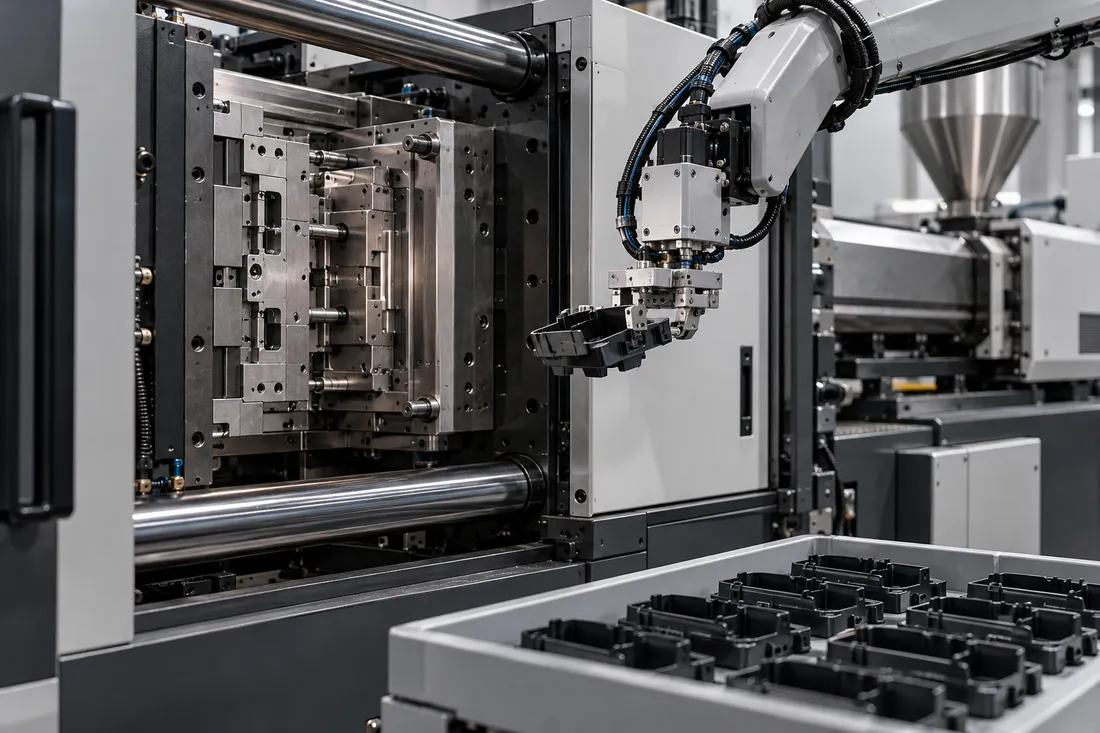
The molding press finishes a part, then the handling queue begins.
Parts move to another station for degating, drilling, deburring, inspection or packing. Those handoffs consume labor, create work in progress and make the finished output depend on several manual steps after ejection.
Repeated transfers after ejection
People carry parts between the press and downstream workstations.
Secondary labor on every part
Degating, checking and packing repeat across the production run.
Handling damage and rework
Hot parts, inconsistent gripping and extra touches can damage the output.
Combine extraction and the secondary work around the molding cycle.
RISEC scopes a robot and end-of-arm tooling to remove the part, complete the included secondary tasks and present finished output. The sequence is designed around the press interface, cooling window and required quality.
Extract the molded part
Coordinate mold clearance, cycle signals and part temperature.
Complete secondary work
Combine suitable degating, deburring, drilling or other included operations.
Inspect and separate rejects
Apply the specified checks and reject-handling route.
Present finished output
Place parts into trays, packing or the next operation without extra transfers.
Where you recover value.
Reduce manual touches per part
Replace repeated carrying and repositioning with one connected sequence.
Reduce downstream work in progress
Move parts through extraction and finishing without a separate handling queue.
Protect repeatable part handling
Use controlled gripping, fixtures and presentation for the selected molded part.
333 hours/year
Removing two 20-second transfers from 30,000 parts eliminates about 333 hours of transfer work each year. Finishing and inspection remain included in the sequence where specified.
How the process works.
Mold opens
Receive the mold-open signal.
Extract part
Extract the part using the selected end-of-arm tool.
Secondary work
Perform the included degating or secondary operation.
Inspect
Complete the specified inspection and reject separation.
Tray placement
Place accepted parts into the finished tray or packing position.
Next cycle
Return ready for the next molding cycle.
Molding extraction combined with secondary operations
Universal Robots describes Midgard’s use of collaborative robots for injection-molding tending and secondary work, reporting payback after about 1,500 operating hours and improved scrap performance for that installation. Read the published case.
Equipment scope and common questions.
Cell design covers mold clearance, machine signals, temperature, deformation, grip marks, fixtures, secondary-task timing, rejects and fault recovery. The handling sequence fits around the press cycle and mold-change procedure.
Is this more than a part-removal robot?
Yes. The selected scope can connect extraction with secondary work and finished-part presentation, removing transfers between those stages.
Can one robot cover several machines?
Layout, press cycles, travel and safe access determine whether a shared arrangement is practical.
Can it handle short production runs?
Short-run suitability depends on gripper, mold and program changeover time. The selected part families define the operating scope.
Remove the manual queue between molding and finished-part presentation.
Tell us about the operation you want to improve. We will help define the equipment, integration and next steps for that application.