Reduce finishing labor and abrasive use across changing part geometries.
Use force-controlled sanding or grinding with suitable sensing and tooling to repeat the required finish on eligible part families.
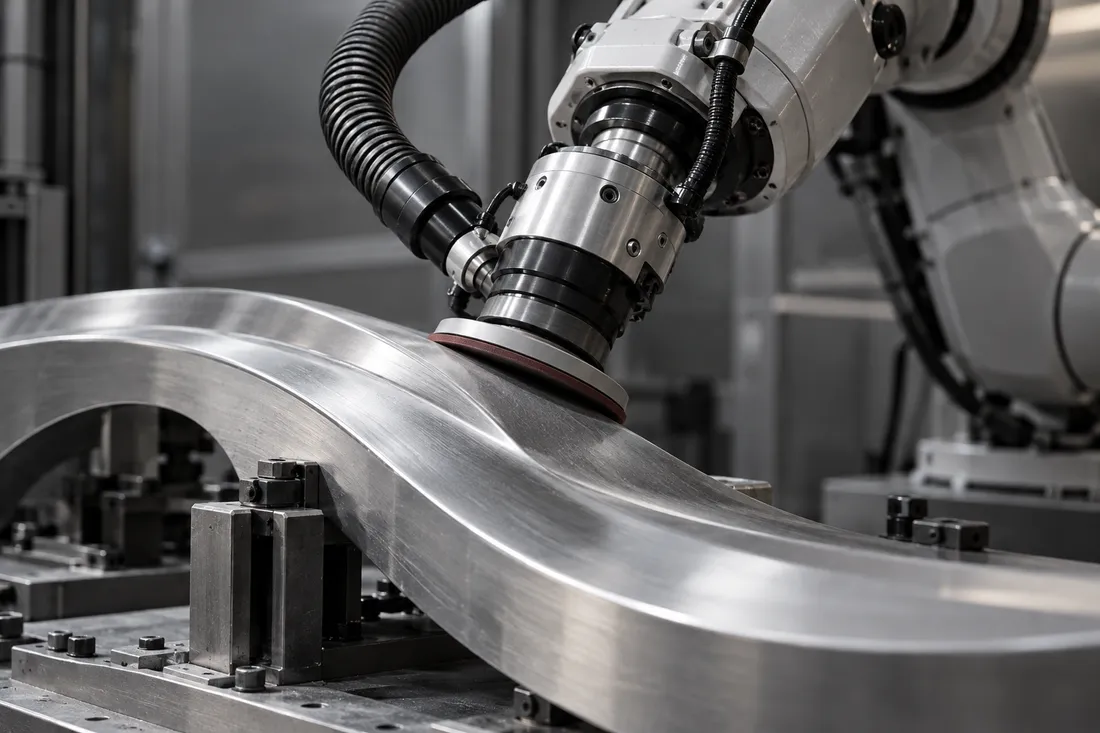
Manual finishing adds skilled touch time to every changing surface.
The operator must adjust pressure and contact as the shape changes. Too much contact damages the surface; too little extends the cycle. Rework and abrasive changes add more time before the part can move on.
Labor-heavy finishing
Every part needs repeated tool contact and surface coverage.
Variable finish and rework
Changing pressure or missed areas send parts back for correction.
Abrasive and changeover cost
Media, programming and part changes consume productive time.
Control contact force and tool motion across the selected part family.
RISEC scopes force-controlled tooling, sensing, fixtures and the finishing sequence with suitable providers. The cell follows the surface while controlling the contact needed for the specified finish.
Establish part and surface position
Use the appropriate fixture and sensing for the geometry.
Control tool contact
Coordinate force feedback, abrasive behavior and surface coverage.
Manage recipes and changeovers
Include the programs, fixtures and media for the selected mix.
Integrate inspection and extraction
Check the finish and manage dust and consumable replacement.
Where you recover value.
Reduce manual finishing time
Repeat eligible sanding or grinding work through a controlled cell.
Use abrasives more consistently
Manage force and contact instead of relying on variable manual pressure.
Increase finished-part capacity
Reduce recurring touch time and rework before downstream assembly or coating.
1,000 hours/year
Removing 5 minutes of manual finishing from 12,000 parts releases 1,000 hours over the year. Abrasives and quality rework are additional cost drivers.
How the process works.
Present part
Present the selected surface and part geometry.
Tool contact
Establish tool contact using the sensing or force feedback.
Control force
Control force and abrasive engagement.
Follow path
Follow the finishing path across the surface.
Check finish
Inspect the required finish.
Change job
Change the part, recipe or abrasive for the next job.
A finishing cell that reduced time and abrasive consumption
FANUC America’s June 2026 RC Industries case reports up to 50% less sanding time, 50% lower abrasive-media use and approximately 33% additional capacity. Read the published case.
Equipment scope and common questions.
The review covers curvature, material, finish criteria, surface access, abrasives, force limits, sensing, fixtures, programming, dust extraction, inspection and changeover between representative parts.
Can one cell handle every product?
The selected geometry, reach, surface access and finishing requirements define the supported part family.
Does it include polishing and inspection?
Those stages can be added when specified in the tooling and process scope.
How is finish accepted?
Representative parts are checked against the agreed surface criteria, along with the required cycle and changeover behavior.
Free skilled hours from repetitive sanding and grinding.
Tell us about the operation you want to improve. We will help define the equipment, integration and next steps for that application.