Increase accepted pipe-spool weld output per shift.
Automate suitable circumferential welds so qualified people can focus on fit-up, preparation, supervision and keeping fabrication work moving.
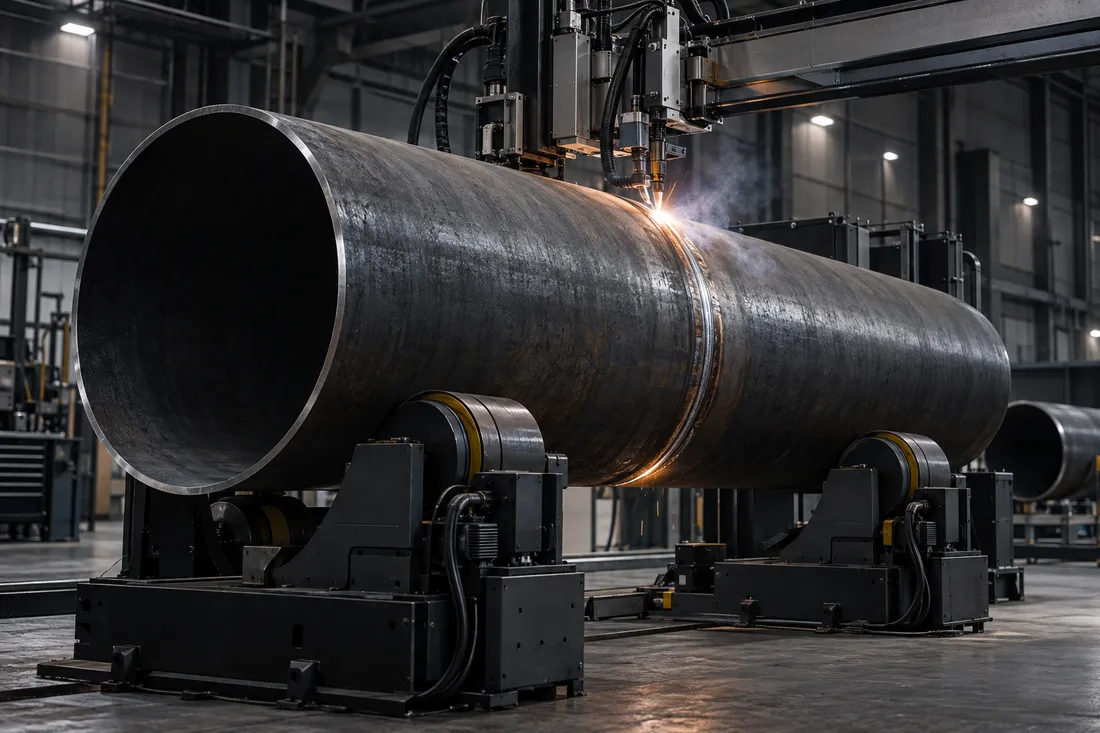
Welding hours can become the constraint on spool delivery.
Fit-up, arc time, rotation, repair and inspection all consume the shift. When welding cannot keep pace with the project, work queues build and delivery depends on overtime or scarce qualified labor.
Limited accepted welds per shift
Manual arc hours and non-weld tasks constrain completed spool output.
Rework uses the same scarce hours
Repairs repeat preparation, welding and inspection before delivery.
Project schedules absorb the delay
Queued spools hold up the next fabrication or installation stage.
Automate the circumferential weld while keeping preparation and quality under control.
RISEC scopes a specialized spool-welding system around your joint families, materials and approved procedures. The project connects welding equipment with spool handling, positioners, monitoring and operator workflow.
Prepare and position the joint
Coordinate fit-up, tacking, spool handling and rotation.
Automate the weld sequence
Apply the selected welding process to eligible circumferential joints.
Support the operator
Include monitoring, training and the loading and supervision routine.
Inspect and release the spool
Keep procedure, inspection and repair requirements within the production sequence.
Where you recover value.
Increase accepted output
Use automated arc work to produce more qualified joints per shift.
Reduce dependence on manual arc hours
Let qualified staff cover preparation, quality and supervision.
Improve schedule capacity
Complete repeated joint work sooner within the fabrication route.
25,000 diameter inches/year
An example increase of 100 accepted factored diameter inches per operating day adds 25,000 over 250 days. Joint mix and the required welding procedure define the production unit.
How the process works.
Joint preparation
Prepare the joint and required materials.
Fit-up
Fit and tack the pipe components.
Position
Position and rotate the spool for welding.
Weld
Run the qualified automated weld sequence.
Inspect
Inspect the weld and complete any required NDE.
Accepted spool
Release the accepted spool into the next operation.
Published pipe-welding output improvements
Novarc’s Worley Cord case reports 230% higher pipe-welding productivity. Its separate Metropolitan Mechanical Contractors case reports output moving from about 60 to 80 to 200 to 250 factored diameter inches per day. Read the first installation or the second installation.
Equipment scope and common questions.
The scope includes pipe diameters, wall thicknesses, material grades, joint preparation, WPS/PQR, spool handling, fixtures, rotators, monitoring, operator training, NDE and service support.
Does the robot qualify our welding procedure?
Procedure qualification, operator requirements and inspection remain part of the welding program and are addressed in the project scope.
Does automation remove fitting work?
Fit-up and material handling remain essential. The system automates eligible welding work around those tasks.
How does this differ from a general welding cell?
Spool geometry, rotation, joint range and procedure requirements call for equipment built around pipe fabrication.
Complete more qualified pipe welds with the team and shifts you have.
Tell us about the operation you want to improve. We will help define the equipment, integration and next steps for that application.