Essentials
$299Monthly prepaid
- Included credits
300
- Maximum monthly volume if using one request type
Up to 300 Direct RFQs
Up to 150 Sourced RFQs
Up to 100 Engineered RFQs
Automate RFQ intake and line-item preparation, organize supplier offers, evaluate delivered costs and profitability, and produce review-ready quotations through one workflow.
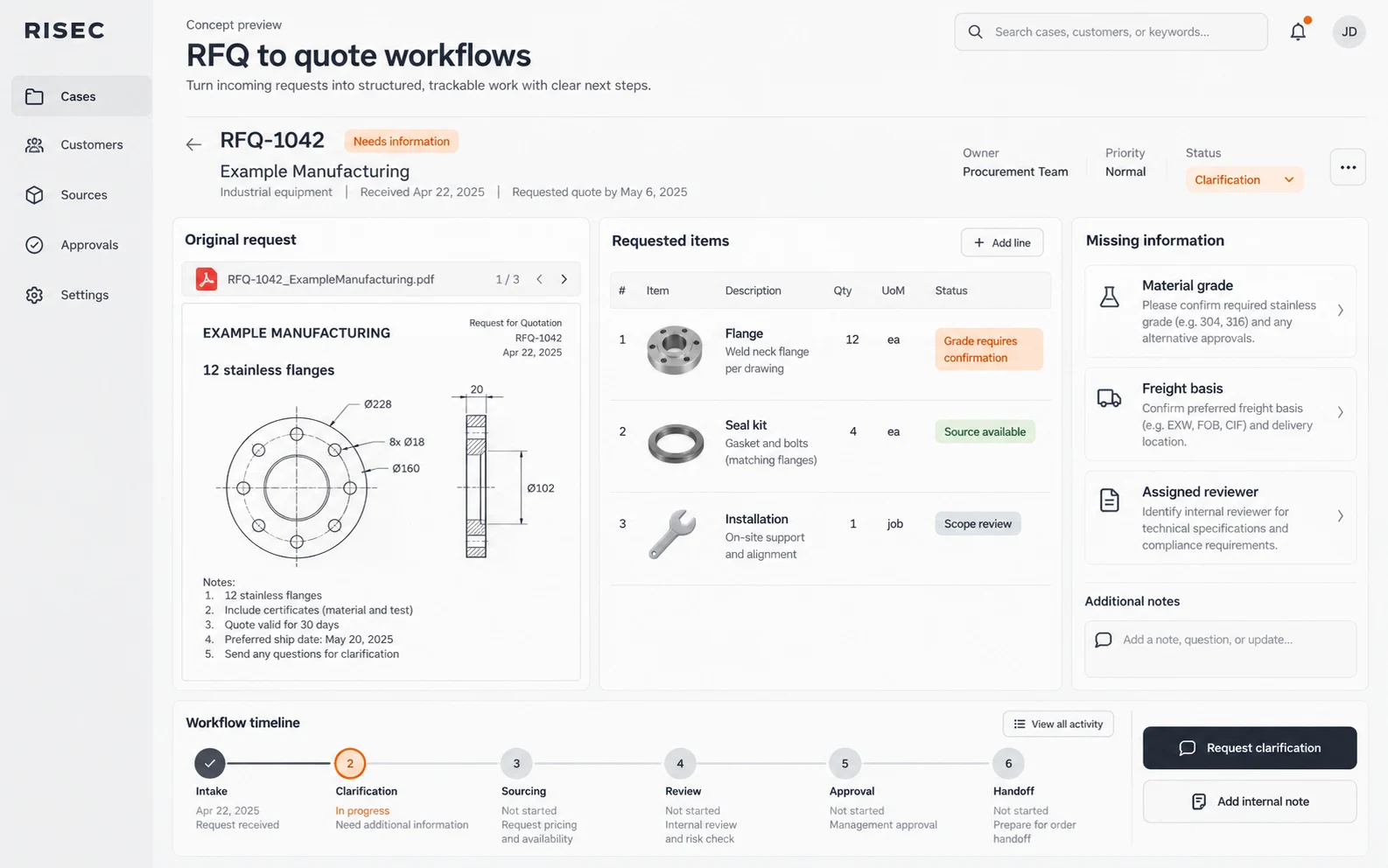
A customer sends a spreadsheet, a drawing and a message asking for price and delivery. Your estimator searches catalog data, identifies missing specifications, contacts suppliers and rebuilds the price. Then someone checks the whole quotation again before it leaves the company.
Automate RFQ to Quote Workflows brings those steps into one controlled process. The solution is designed to read incoming requests, structure requirements, work with approved source information, prepare commercial options and place the exact customer quote in front of an authorized reviewer.
Authoritative item and rate sources. Named commercial approvers. Defined downstream order ownership. Explore the steps to see what must be recorded or verified.
Resolve missing specifications before choosing a source.
Unresolved facts remain visibleRetain the original request and its attachments.
Workflow illustration. Intended scope is verified for each deployment.
Part numbers may be incomplete. Technical requirements may be ambiguous. A requested substitute may need approval. Shipping can change the final economics. A customer might ask for goods, services or both.
The workflow keeps each unresolved decision visible. It uses source facts and deterministic pricing logic where authority exists, requests clarification when necessary and preserves the original evidence. The goal is a reviewable commercial decision, not an automated guess that looks convincing.
Bring email RFQs, manually entered requirements and supported document uploads into a common case. The V1 specification includes PDF, spreadsheets, Word files, images and direct entry, subject to deployed connection readiness.
Extract and organize product or service requirements while retaining the source message and attachments. Staff can check a line against the original document when the interpretation is uncertain.
Work from mapped catalogs, approved supplier data and relevant product attributes. Exact identity, applicability and substitute decisions remain subject to the configured controls.
Track supplier and service-provider requests, replies and clarification. Freight is treated as part of a defined fulfillment route rather than as an arbitrary extra line on the customer quote.
Build up the eligible source cost, freight and approved pricing rules. Explicit unknowns remain unknown. A model cannot invent a supplier price, tax rule or profit margin.
Review pricing, terms, alternatives and changes before anything is sent to the customer. Accepted business moves to an auditable order and supplier-PO preparation process without claiming to replace the customer's ERP.
Proposed interface concepts. Intended features require implementation and a verified demonstration.
Keep the original RFQ, attachment, line reference and interpreted requirements side by side. The system is specified to prioritize authoritative identity and appropriate source attributes, then surface ambiguity, substitute conditions or missing engineering facts for authorized review. A similar-sounding description alone does not justify substituting a part.
A quote can involve existing warehouse stock, buying through a supplier, an internal transfer or direct shipment. The workflow models the selected procurement route and relevant freight legs, currency and terms, rather than comparing supplier unit prices in isolation. Where the customer will arrange shipping or freight is genuinely undetermined, the quote must disclose that instead of silently assigning a convenient cost.
A service-only request, a preapproved service package or a mixed equipment-and-service request can stay in one commercial case. The specified workflow supports authorized rates or quoted service prices, conditional cost checks, delivery commitments and payment schedules when those facts are available. It does not pretend to dispatch field technicians or run the job after acceptance.
The case retains original messages, dated source facts, line-level requirements, supplier offers, calculated options, requested clarifications and human overrides. Approved terms and commercial limits are checked before a customer quote is sent. Staff can see why a line is blocked, why an option was preferred and who approved an exception.
A later revision, changed supplier cost or revised delivery estimate should not quietly rewrite a previously accepted quote. The specified handoff binds acceptance to the exact sent revision, supported customer PO evidence, pricing, delivery basis and procurement details. The next team can then prepare supplier purchase orders and handle exceptions with an auditable record.
When a request spans 40 lines, two drawings, three suppliers and a shipping deadline, the expensive work is not typing the customer's email into a form. It is resolving exactly what was requested, where the material can come from and whether the final price is commercially acceptable. Automate RFQ to Quote Workflows is designed to organize that work into decisions your team can review.
Bring customer messages and their attachments into a tracked quotation case from a configured mailbox.
Accept PDF, spreadsheet, CSV, document, image and manual request inputs through the same controlled workflow.
Handle an equipment component, a paid installation task or a combined material-and-service request without forcing everything into a parts-only quote.
Preserve the recipient, destination, requested timing and relevant commercial context that can change a valid quotation.
Keep the source request and messages available next to interpreted requirements, so an estimator can verify what the customer actually said.
Avoid charging or processing the same intake twice and distinguish an amendment from an unrelated new request.
Capture the product or service requirements needed for a quote and reveal unit or dimensional ambiguity before it becomes a price error.
Ask targeted questions when a size, grade, installation scope, payment term or delivery basis is missing rather than manufacturing an answer.
Use approved mapped business sources, including structured file or sheet feeds where supported, as the basis for available items and commercial data.
Identify plausible candidate parts, then validate critical dimensions, units, source identity and required constraints before selecting one.
Invoke approved engineering configuration methods only for supported product families that genuinely need engineering assessment; unsupported engineering moves to review.
Mark unresolved or unsuitable lines explicitly; do not silently substitute a similar-looking product.
Request external costs or availability for goods and services, collect replies and preserve the source and validity of each commercial offer.
Keep proposed substitutes distinguishable from the requested item, including the reasons and approval authority.
Surface expired supplier terms or stale availability instead of assuming that yesterday's price is still a current commitment.
Track unanswered requests, approaching deadlines and the point at which a team member must intervene.
A cheap source quote can become an unprofitable customer quote after freight, currency, different delivery routes and contractual terms are considered. The system helps compare feasible options on the basis actually being offered to the customer.
Open a difficult RFQ with material and installation lines. Follow the original files into structured line requirements, show where a supplier answer is missing, compare the delivered cost of supported fulfillment routes, inspect the draft quotation, and explain exactly what an authorized person approves. Finally, show how a customer's explicit acceptance becomes an order or procurement handoff.
Important scope distinction: This is not a replacement accounting system, manufacturing execution platform or field-service dispatch system. A complete unattended quoting agent, disconnected integrations and engineering skills that have not been implemented are not included as working capabilities. The product specification defines the intended capability; a verified demonstration establishes what is available for a given deployment.
Evaluate supported fulfillment choices without equating supplier price with landed cost.
Consider origin, destination, package context, internal freight rules and external freight quotations where required.
Keep unknown or customer-arranged freight visible in the commercial quote rather than hiding it inside an unjustified total.
Apply valid rates, units, rounding and money constraints through controlled calculation rather than unrestricted language-model arithmetic.
Use eligible source rates, packages, quantities, travel or material assumptions where service work is being quoted.
Evaluate configured price floors and cost-plus rules when applicable before inviting a final approval.
Present supported viable choices with their costs, delivery implications, sources and reasons.
Allow an authorized person to correct or override an option with a preserved reason and evidence instead of rewriting history.
Hold final customer-facing commercial terms for an authorized approver before sending.
Revisions preserve the prior approved offer and the exact details sent to the customer.
Link an explicit acceptance email, customer purchase order or authorized confirmation to the appropriate sent revision.
Require review when the accepted requirements materially differ from the quotation instead of silently converting them to an order.
Preserve items, service scope, quantities, units, prices, delivery, ship-to, terms and source decisions for downstream processing.
Prepare supported procurement handoff records, with validation before external supplier commitment.
Create a supported order in a properly verified ERP connection when that integration is part of the deployment.
See cases waiting on customers, supplier offers, pricing checks, approvals or procurement actions.
Inspect key decisions, source evidence, messages, overrides, quote revisions and external effects without relying on an AI-generated summary as the legal record.
Separate operator, approver and administration rights; surface broken inputs and connection issues before a user trusts an incomplete workflow.
A parts reseller may receive thirty lines with conflicting part references. An MRO distributor may need supplier availability on half the order. A service business may quote equipment and installation work together. These aren't identical jobs, and the system is designed to preserve their different sourcing, cost and approval requirements in a consistent case record.
Enter your actual monthly request volume and measured handling time. The analysis shows how much capacity might be released at different verified time reductions. It will not assign an arbitrary higher win rate or treat freed estimator hours as automatic payroll savings.
There is not yet an independently verified RISEC customer productivity result for the quoting platform. We will use a real workflow demonstration and documented, customer-specific pilot measurements rather than presenting a fictional quoting benchmark.
Use measured handling times for comparable requests. Released hours are not automatically payroll savings.
Enter your values to calculate a scenario. Inputs stay in your browser.
Requests per year × (minutes before − minutes after) ÷ 60
Illustrative calculation, not a quote or guarantee. Operating inputs are not sent with an enquiry.
300
Up to 300 Direct RFQs
Up to 150 Sourced RFQs
Up to 100 Engineered RFQs
850
Up to 850 Direct RFQs
Up to 425 Sourced RFQs
Up to 283 Engineered RFQs
1,650
Up to 1,650 Direct RFQs
Up to 825 Sourced RFQs
Up to 550 Engineered RFQs
Agreed in proposal
More than 1,650 credits per month
Negotiated processing volume or workflow scope
A Direct RFQ uses 1 credit, a Sourced RFQ uses 2 credits, and an Engineered RFQ uses 3 credits for the authorized whole request, not each line. Mixed workloads draw from the same monthly credit balance. Credit allowances define processing volume, while request eligibility depends on the supported file types, authoritative source data and workflow scope. Implementation fees dependent on your organisations requirements. Additional integrations, data preparation and assisted onboarding are scoped separately where required.
The system is intended to retain evidence, authorized prices, reviews, approvals and case histories. It does not replace accounting, production, warehouse fulfillment or a general service-management suite. Initial onboarding is assisted, and the exact supported source connections are verified before deployment.
The specified V1 uses explicit authorized approval of customer-facing commercial commitments. Can it use our existing data? Supported mapped source records and qualified connections can be used after setup. Will it find suppliers on its own? The workflow can manage bounded external requests, but source access, authority and operational capability must be established. Does every attachment become a valid quote automatically? No. Ambiguity, missing data and unsupported engineering cases remain visible and may require human input.
We'll review its structure, the price and supplier sources you rely on, and which steps can responsibly move into a controlled workflow.