ERP Core
$999Monthly from
- Suitable starting scope
1 legal entity
1 facility
Up to 10 supported users
Defined purchasing, stock and accounting workflow
Connect sales orders, material planning, procurement, manufacturing work orders, inventory movements, invoicing, and financial accounting without duplicating records across disconnected tools.
When sales, purchasing, stores, production and accounts all maintain their own versions of the same transaction, your team spends too much time reconciling what has happened. A customer order changes, purchasing works from an old quantity, production has a different part list and finance has to investigate the difference at month-end.
Manufacturing ERP brings these operational and financial records into a connected ERP deployment. We scope the implementation around the processes your business actually uses and the data it can reliably migrate.
Reconciled item and financial data. Written department responsibilities. Accounting and cutover sign-off. Explore the steps to see what must be recorded or verified.
Modules, approval rules and accounting behavior are configured and validated within the agreed rollout.
Preserve the confirmed commercial requirement.
Connected-transaction illustration. Modules depend on the agreed rollout.
The transaction has agreed items, quantities and commercial information.
A finished item may come from existing stock or need production. The manufacturing record can draw on a bill of materials and routing where configured.
Supplier orders, warehouse transactions and receipt records support the movement of materials through the system.
Work orders, material transfers, job cards and finished-stock transactions reflect the deployed manufacturing configuration.
Invoicing, receivables, payables, accounting entries and reports can be maintained within the same enterprise system instead of duplicated across disconnected tools.
Imagine a customer adds another unit to an order after purchasing has already placed the material request. Sales needs to know whether the promised date still holds, purchasing needs revised demand, production needs accurate work quantities and finance needs the final transaction. A connected order history gives each department the basis for its next decision without rebuilding the record in a separate spreadsheet.
Customer quotations and sales orders can relate to stock availability, purchasing, delivery and fulfillment records. When configured properly, the sales team does not have to maintain a disconnected spreadsheet of what production says it can supply.
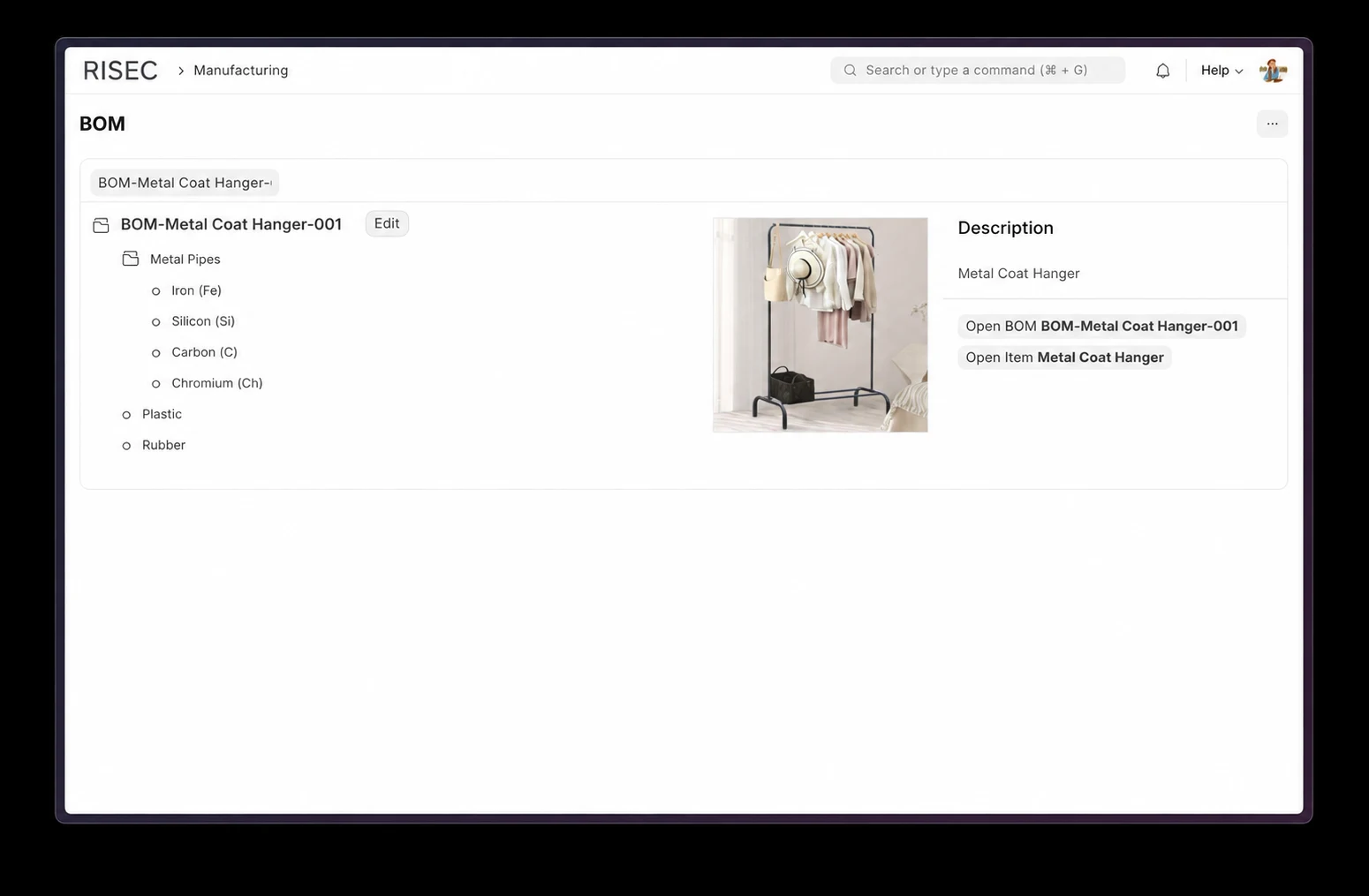
Multi-level bills of materials, routing, work orders and job cards give production a structured basis for the work. Material requests, warehouses, transfers, production consumption and finished-goods receipt keep physical changes linked to the manufacturing records. Where required, evaluate production planning, capacity constraints, subcontracting and serialized or batch-controlled materials.
Supplier purchasing, incoming stock, landed cost and valuation, sales invoicing, accounts payable/receivable and general-ledger entries belong in a controlled transactional environment. Which accounting rules, taxes, inventory valuations and reports are appropriate depends on the customer's entity and jurisdiction. The system is not a substitute for professional accounting review.
The ecosystem also includes projects and timesheets, asset life cycles, maintenance records, quality inspections, customer records, workflow approvals, reports and role-based permissions. We should propose these only when they contribute to the operating problem, not bundle every module into an expensive migration by default.
Permissions, approval flows, traceable transaction links, print formats, imports, reports and APIs help different departments work with consistent records. For a manufacturer moving from separate tools, the implementation should include master-data preparation, reconciliation of opening balances, staged validation and an agreed cutover rather than a promise to switch overnight.
ERP creates value when a change to an order or material movement needs to be understood by several departments. It is also a substantial operational change, so the most credible proposal starts with one complete business transaction, the records it must update and the staff responsible for making each step correct.
For a component assembler struggling only with stock and BOMs, Inventory Management may be the lower-risk entry point. For a manufacturer suffering from disconnected purchase orders, production orders, deliveries and finance, the value of ERP comes from connecting the full transaction chain. We will scope reporting, tax setup, migration, process changes, support and integrations in writing before proposing a production cutover.
Implementation boundary: Finance localization, opening balances, reconciliation, roles, supplier workflows and custom reports require configuration and sign-off. Additional applications are not automatically part of a standard ERP deployment. The proposal defines the services, hosting, support and ownership of any commissioned custom work.
Preserve confirmed item, quantity, price, date and customer details as the commercial starting point.
Keep relevant account information alongside transactions for teams handling orders and follow-up.
Record goods delivered against the applicable order and maintain the expected commercial trail.
Connect material demand to the suppliers and physical receipts that fulfill it.
Use consistent item descriptions, supplier references, price lists, units and purchasing context across departments.
Configure relevant locations and current quantities for purchasing, production and delivery decisions.
Record planned replenishment and movement into, through and out of production.
Preserve required physical-unit and lot traceability where the company actually captures the records.
Define the components and quantities required for finished goods and intermediate assemblies.
Describe work-center steps and the relevant labor or machine operations.
Turn production demand into a controlled work request and its material requirements.
Record supported operation and work-center execution against production work.
Assess material demand and work requirements using the planning tools appropriate to the configured process.
Review selected work-center capacity and scheduling considerations; finite scheduling quality depends on actual master data and process fit.
Tie material transfers and consumption to the relevant work order rather than adjusting finished stock without history.
Capture supported external manufacturing or processing arrangements and the related material/accounting records.
Apply configured incoming or production quality inspections where the deployed module supports the company's requirements.
Review inventory valuation, material cost and supported manufacturing transactions without promising automatic correct job profitability from poor source data.
Track invoices, customer and supplier balances and supported payment records.
Record business transactions in a defined accounting structure rather than rebuilding monthly journals from spreadsheets.
Produce configured balance-sheet, income-statement and related finance outputs from the transactions actually recorded.
Configure supported entities, taxes and currencies with accounting validation appropriate to the jurisdiction.
Associate supported costs or transactions with relevant organizational structures for financial analysis.
Link purchases, relevant additional acquisition costs and stock valuation where accounting policy requires it.
Manage supported asset lifecycle, maintenance and related records when these modules are in scope.
Apply project management functions for businesses that deliver engineered projects or internal work.
Restrict sensitive financial or operational changes to the right staff, with controlled records and history.
Bring reliable master data into the deployment and connect agreed third-party applications through tested interfaces.
Generate suitable transaction paperwork without assuming every customer-specific layout comes preconfigured.
If the immediate problem is BOMs, stock locations and production allocations, Inventory Management may solve it with less disruption. A full ERP is more appropriate when your business wants manufacturing and purchasing to share transaction data with finance and customer-order processes.
1 legal entity
1 facility
Up to 10 supported users
Defined purchasing, stock and accounting workflow
1 legal entity
Up to 3 facilities
25 supported users
Connected production, purchasing and finance workflows
Up to 2 legal entities
5 facilities
50 supported users
Staged cross-functional rollout
Custom scope if any Operations limit is exceeded:
2 legal entities
5 facilities
50 supported users
Complex migration, localization or integrations
Implementation fees dependent on your organisations requirements. Hosting, support, data migration, finance localization and rollout milestones are confirmed in the written proposal. The monthly plan sets the managed service footprint; it does not remove ERP capabilities from the configured solution.
We start with a process map and the quality of your master data. Choose a practical initial scope, demonstrate how the system behaves with representative products and orders, agree accounting and purchasing rules, reconcile migrated data and train the staff responsible for each step. Integrations, customizations and implementation schedule are quoted after this discovery.
The financial case can include current recurring system costs and genuinely avoidable re-entry or reconciliation effort. It should also include implementation and training costs, plus operational disruption during transition. We won't assume that replacing two software subscriptions automatically makes an ERP project pay for itself.
It can perform accounting functions, but fit, migration and reporting requirements must be validated. Can we keep existing machines and shop-floor applications? Yes if interface needs are scoped; a dedicated MES may remain appropriate. Can we bring over our old transactions? We assess required history and reconciliation before committing. Will you configure everything Manufacturing ERP offers? No. Only the modules and workflows in the agreed implementation scope.
We'll look at where it starts, who changes it, which systems hold it and what a realistic ERP implementation would involve.