Recover paid-for cutting fluid and get more value from machining scrap.
Separate coolant or cutting oil from chips, reduce bulky scrap handling and prepare a better-controlled metal stream for collection or sale.
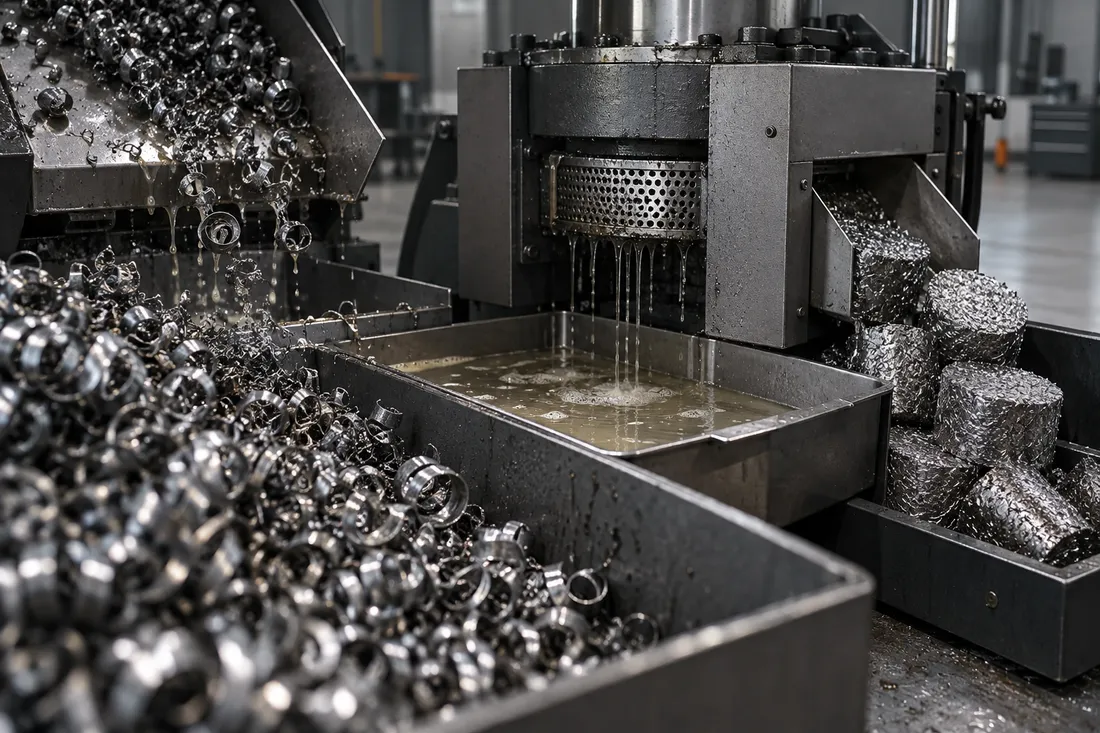
Wet chips carry money out of the machining shop.
The fluid in your scrap bin was purchased for machining. When it leaves with the chips, you buy replacement fluid, move heavier or bulkier waste and give up floor space to material waiting for collection.
Cutting fluid leaves with scrap
Usable coolant or oil becomes a replacement purchase when it leaves the shop.
Bins consume space and handling time
Bulky chips drive bin changes, transport, housekeeping and collection activity.
Scrap value is harder to control
Retained fluid, mixed metals and inconsistent output affect the grade your buyer accepts.
Separate the fluid, control the scrap and reduce bin handling.
RISEC scopes chip reduction, centrifugal wringing or briquetting around the metal and fluid you produce. Recovered fluid is routed for quality checking and reuse; processed metal is prepared to the scrap buyer’s accepted form.
Reduce and feed the chips
Prepare eligible chip shapes for reliable separation and throughput.
Separate retained fluid
Use a wringer or suitable recovery stage to remove coolant or cutting oil.
Compact where it adds value
Briquette suitable metals to reduce bulk and simplify handling.
Route both recovered outputs
Collect fluid for reuse checks and metal for controlled storage or sale.
Where you recover value.
Buy less replacement fluid
Recover usable coolant or oil before it leaves the plant in the scrap stream.
Reduce handling and floor-space pressure
Denser, better-controlled scrap reduces the burden of bins and collections.
Improve control of scrap proceeds
Match processed metal to documented buyer grades and collection terms.
2,500 gal/year
Recovering 10 gallons of usable fluid per operating day over 250 days keeps 2,500 gallons in circulation. At an example $8/gallon replacement cost, that represents $20,000 of fluid purchases.
How the process works.
Wet chips
Collect wet chips from the machining operation.
Chip preparation
Reduce and separate chips in the recovery equipment.
Fluid recovery
Collect the recovered cutting fluid.
Metal processing
Discharge processed chips or compacted briquettes.
Quality check
Check fluid condition and prepare accepted outputs.
Reuse and collection
Return usable fluid and move metal to collection.
A chip-handling system that recovered oil and reduced handling
PRAB reports that Anthony Screw Products replaced its earlier chip-handling arrangement with a crusher/wringer system, improving oil recovery, scrap handling, floor-space use and maintenance. Read the published installation.
Equipment scope and common questions.
The equipment scope covers chip material, shape, throughput, retained fluid, mixed metals, footprint, conveyors, fluid storage, guarding and maintenance access. The scrap buyer’s specification and the machine-fluid requirements determine the output routes.
Do we need both wringing and briquetting?
Not necessarily. Wringing separates fluid; briquetting also changes the metal’s form. The scrap stream determines which stages add value.
Can the recovered fluid return to machines?
Fluid is checked for condition and compatibility before reuse, with filtration or conditioning included where required.
Does one system handle every metal?
Aluminum, steel and other chip forms have different handling and processing requirements. Material samples help select the equipment.
Keep cutting fluid in the shop and reduce the cost of moving chips.
Tell us about the operation you want to improve. We will help define the equipment, integration and next steps for that application.