Keep CNC machines cutting instead of waiting for the next load.
Automate repeatable loading, unloading and selected secondary work to increase productive spindle time and reduce manual handling between cycles.
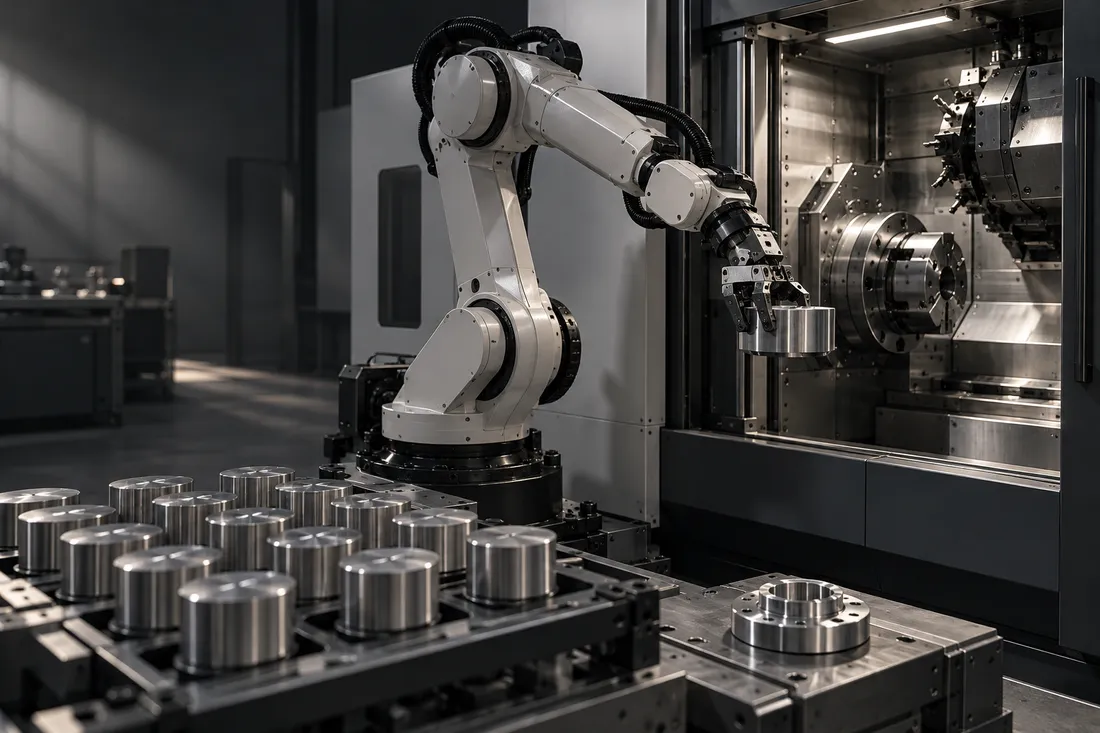
A finished part should not leave the spindle waiting for an operator.
Every delayed unload, fixture clean and reload extends the gap between cuts. Across machines and shifts, those gaps consume capacity you already own and can push orders into overtime or later delivery dates.
Paid machine capacity sits idle
The spindle waits while operators move between machines or handle other tasks.
Extra shifts absorb handling losses
More staffed hours are used to achieve the same production requirement.
Manual touches interrupt output
Inspection, deburring and part transfers compete with timely machine loading.
Automate the handling cycle around your existing machining work.
RISEC scopes a tending cell with suitable providers, integrating part presentation, gripping, machine access and finished-part handling. Selected inspection or deburring operations can be included in the same sequence.
Present and grip the blank
Make part pickup repeatable across the agreed part family.
Integrate the machine interface
Coordinate doors, fixtures, cycle signals and interlocks.
Unload and handle finished parts
Move parts into storage or the next included operation.
Support sustained operation
Include tool checks, fault recovery, supervision and operator access.
Where you recover value.
Recover productive spindle time
Reduce waiting between completed cuts and the next load.
Free operators from repetitive handling
Let staff cover setup, inspection and other productive work.
Add production capacity within the cell
Use repeatable tending to support longer operating windows and meet outstanding demand.
8.3 hours/day
One minute of waiting across 500 daily cycles consumes 500 minutes, or 8.3 machine-hours. Removing that waiting gives the spindle more time for cutting.
How the process works.
Present blank
Present the next machining blank.
Load machine
Load and locate the part in the machine fixture.
Machining
Run the machining cycle.
Unload
Unload the finished part and clear the fixture.
Check part
Complete the included inspection or secondary task.
Finished output
Stage finished output and begin the next cycle.
A machining operation that reduced cost and increased throughput
Universal Robots reports that Toolcraft’s multi-operation CNC tending installation reduced production costs by 23% and increased throughput by 43% in the reported operation. Read the published case.
Equipment scope and common questions.
The cell scope includes grippers, presentation, doors and cycle interfaces, fixtures, part storage, guarding, inspection, fault recovery, changeovers and maintenance. Setup and the required supervision are included in the operating plan.
Can we automate an existing CNC?
Existing machines can be candidates when physical access, controls and safe cycle interfaces support integration.
Can one cell handle mixed parts?
A defined family can use changeable grippers, fixtures and recipes. Part size, batch length and changeover work determine the practical range.
Can it operate after the staffed shift?
Extended operation needs reliable material supply, tooling, checks, fault handling and the appropriate safeguarding and supervision.
Turn waiting time between CNC cycles into productive machine time.
Tell us about the operation you want to improve. We will help define the equipment, integration and next steps for that application.