Produce more repeatable weldments with less manual welding and handling.
Combine robotic welding, reliable fixtures and coordinated part exchange to increase accepted output on recurring assemblies.
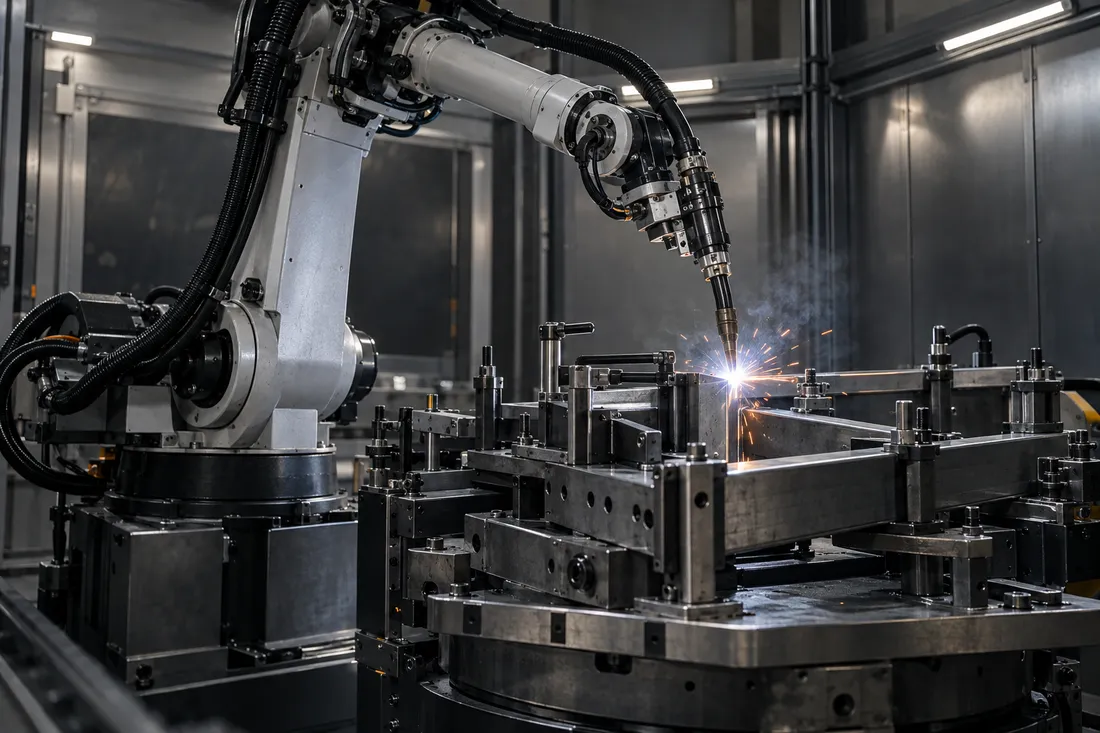
Repeated weldments consume skilled hours that the shop cannot easily replace.
The same assembly is loaded, located, welded and checked again and again. Variable fit-up, handling and repair work reduce completed output and tie experienced welders to repeat production.
Skilled labor spent on repetition
Recurring weld paths occupy people needed for setup and complex fabrication.
Fit-up variation creates repair work
Inconsistent location and joint preparation produce unstable weld results.
Handling limits the cell
Loading, clamping, exchange and changeovers consume time outside arc-on work.
Build a complete cell around the weldment, fixture and part exchange.
RISEC scopes the robot, welding process, positioners, fixtures and workflow with suitable providers. The aim is a repeatable accepted assembly from loading through inspection, rather than a robot following a path in isolation.
Locate and clamp repeatably
Use fixtures that control part position and weld access.
Apply the qualified weld process
Coordinate power source, torch, positioner and programmed sequence.
Manage part exchange
Include safe loading, unloading and the remaining manual work.
Maintain production quality
Define inspection, maintenance, training and fault recovery.
Where you recover value.
Increase assemblies per shift
Repeat the selected welding work through a coordinated cell cycle.
Reduce variable repair work
Control the fixture, weld settings and handling around recurring assemblies.
Use skilled people more effectively
Move eligible repeat welding to the cell while operators manage loading and quality.
500 hours/year
Removing 3 minutes of repeat manual weld work from 10,000 assemblies releases 500 hours per year for loading, quality and other fabrication work.
How the process works.
Load fixture
Load the assembly into the fixture.
Locate and clamp
Locate and clamp the components.
Weld
Run the programmed weld sequence.
Part exchange
Exchange or unload the welded assembly.
Inspect
Inspect the required welds and dimensions.
Accepted assembly
Release accepted assemblies for the next operation.
Robotic welding increased output on a repeat gate line
FANUC America reports at least a 37% production increase at Hutchison Inc., with steel-gate output moving from about 8 to 10 to 11 to 13 per hour. Read the published case.
Equipment scope and common questions.
Design covers part tolerances, weld access, distortion, tacking, fixture changes, power source, torch maintenance, fume extraction, guarding, programming and acceptance tests. Stable part families with recurring demand are the primary fit.
Will we need dedicated fixtures?
Many cells use dedicated or modular fixtures to hold the selected assemblies repeatably. Fixture cost is included in the quotation.
What work remains manual?
Loading, tacking, inspection and recovery depend on the chosen cell. Those responsibilities are stated in the operating scope.
Can it handle high-mix fabrication?
Defined part families can share a cell where programming, fixture and changeover work support the mix. One-off fabrication needs a different approach.
Take repeat welding work off the critical path to delivery.
Tell us about the operation you want to improve. We will help define the equipment, integration and next steps for that application.