Automate repetitive pallet stacking and keep finished cases moving.
Stack cases or eligible bags to the required pallet pattern while reducing manual lifts, repetitive turning and end-of-line staffing pressure.
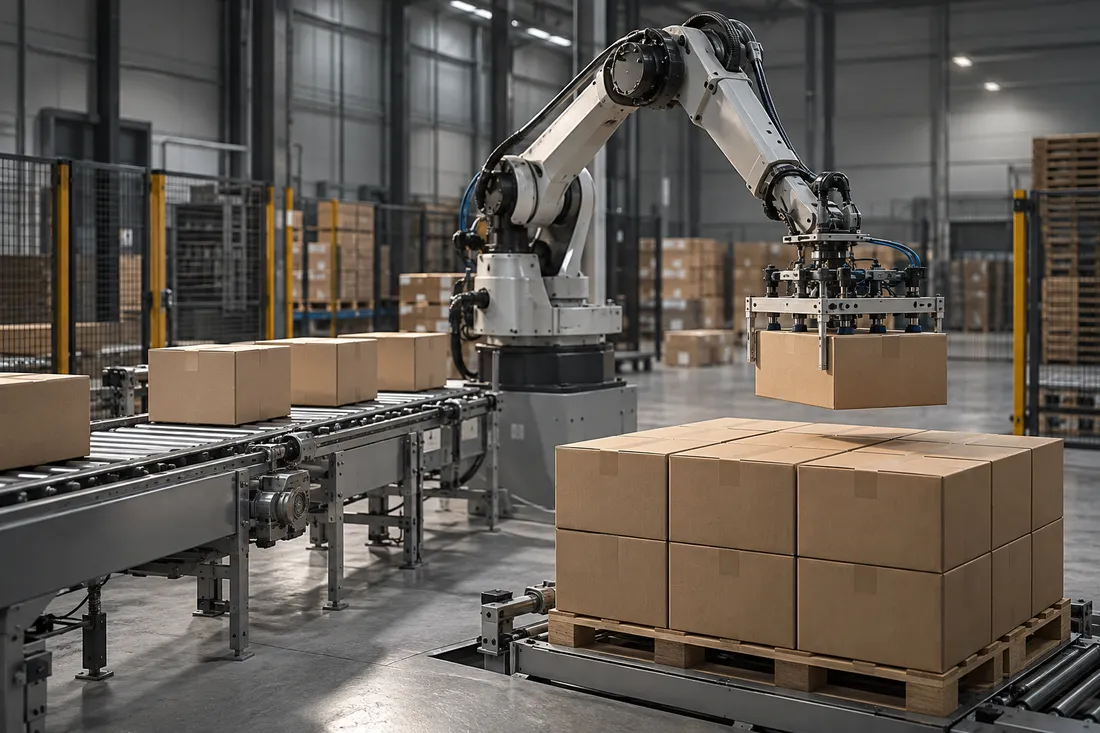
Every finished case still needs someone to lift and stack it.
As production volume grows, palletizing repeats the same lift, turn and placement thousands of times. The workload ties people to the end of the line and can make shift coverage and shipment flow harder to maintain.
Repetitive manual lifting
Workers handle the same weights and movements throughout the shift.
Staffing pressure at the line end
Output depends on keeping the stacking position covered.
Pallet changes disrupt flow
Case arrivals, layer patterns and outbound handling must stay coordinated.
Move finished products from the conveyor into stable pallet patterns.
RISEC scopes a palletizing cell around carton or bag weights, line speed, pallet patterns and available space. The scope connects gripping and stacking with the required conveyors, pallet exchange and outbound handling.
Grip the finished product
Match the handling tool to the carton, bag or eligible payload.
Build the approved layer
Place each item in the specified arrangement and orientation.
Manage sheets and pallet exchange
Include slip sheets, pallet supply and changeover as required.
Connect outbound handling
Coordinate finished pallets, safety zones and downstream wrapping or collection.
Where you recover value.
Remove repetitive stacking lifts
Transfer eligible manual lifts and turns to the cell.
Keep output moving across shifts
Support the case rate with a repeatable stacking sequence.
Release end-of-line labor
Move staff toward replenishment, checks and other work instead of every lift.
4,000 lifts/shift
At 500 cases per hour over eight hours, manual palletizing requires 4,000 case lifts. A palletizing cell takes over the stacking sequence for those cases.
How the process works.
Product arrival
Receive the case or bag at the pickup position.
Pick
Grip and lift the product.
Layer pattern
Place it into the programmed layer pattern.
Stack
Build successive layers to the required height.
Pallet exchange
Complete the pallet and perform the pallet exchange.
Outbound handling
Transfer the finished pallet for outbound handling.
Palletizing that removed thousands of repetitive movements
Universal Robots reports that OPW eliminated 50,000 bends, twists and lifts per year and achieved $45,000 in productivity and safety-related savings in its palletizing installation. Read the published case.
Equipment scope and common questions.
Selection covers payload, case integrity, dimensions, pickup orientation, layer patterns, reach, stack height, conveyors, dispensers, sheets, wrapping interfaces, safe access and fault recovery.
Is case packing included?
Packing prepares the case; palletizing stacks finished cases or other eligible products. Both can be scoped together.
Can it handle changing SKUs?
The specified payloads, dimensions and pallet recipes define the supported range and changeover procedure.
Can people work beside the cell?
The safe arrangement depends on the equipment, task, risk assessment and required guarding or separation.
Reduce repetitive lifting without making pallet stacking the bottleneck.
Tell us about the operation you want to improve. We will help define the equipment, integration and next steps for that application.