Reduce manual blasting hours while delivering the specified surface finish.
Automate repeatable abrasive passes on eligible surfaces to improve coverage consistency and reduce direct manual work in demanding blasting conditions.
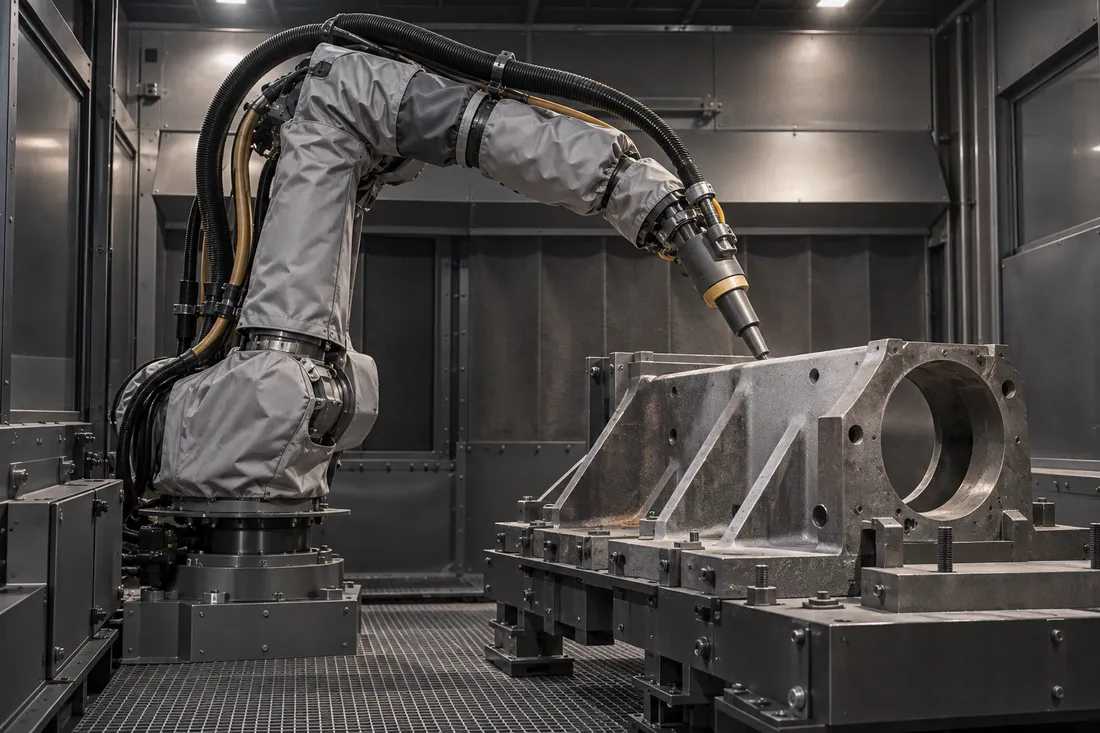
Large surfaces multiply crew hours, abrasive use and cleanup.
Operators repeat passes over tanks, plates, structures and fabricated parts until the required cleanliness and profile are reached. Missed areas and inconsistent preparation send the crew back over work already performed.
High manual preparation hours
Area, access and repeated passes consume crew time before coating can begin.
Abrasive and cleanup expense
Media handling, containment and disposal grow with the work.
Rework delays coating
An unacceptable surface must be prepared again before the next stage.
Control the blasting pass, coverage and media-handling operation.
RISEC scopes a robotic manipulator or crawler around the surface, coating and preparation standard. The solution combines suitable motion and nozzle control with containment, extraction and residual handling.
Plan repeatable coverage
Address surface shape, access and obstructions in the pass sequence.
Control process parameters
Coordinate media, nozzle position and pass behavior for the preparation requirement.
Reduce direct manual exposure
Move eligible blasting motion to remotely operated or automated equipment.
Contain and collect residuals
Include extraction, abrasive recovery, cleanup and waste handling.
Where you recover value.
Reduce manual time over repetitive areas
Automate eligible passes instead of repeating them by hand.
Improve finish consistency
Control coverage and process parameters to support the required profile.
Reduce avoidable media and rework
Focus effort on accepted surface preparation and fewer repeated passes.
250 crew-hours
Reducing preparation by 5 minutes per accepted square meter across 3,000 m² releases 250 crew-hours. Surface condition and the preparation standard define the work.
How the process works.
Surface requirement
Identify the substrate, coating and required surface condition.
Coverage plan
Plan coverage around the surface and access.
Controlled pass
Apply controlled abrasive passes.
Containment
Contain dust and collect spent media.
Inspect finish
Inspect cleanliness and surface profile.
Accepted surface
Release the prepared area for coating or the next process.
Research on controlled robotic surface preparation
Published research on robotized abrasive blasting examines control of blast parameters to reach the required surface roughness and cleanliness. Read the research summary.
Equipment scope and common questions.
The project covers substrate, coating, orientation, access, preparation grade, profile, media, nozzle conditions, containment, dust extraction, access equipment and disposal responsibilities.
Can it remove every coating?
The coating, substrate and required finish determine the abrasive process and sample trial.
Will scaffolding disappear?
Access is part of the equipment design. Some surfaces still require staging or other access equipment.
Who manages dust and waste?
The project scope assigns containment, extraction, residual handling and the applicable site responsibilities.
Reduce the labor tied up in repetitive surface preparation.
Tell us about the operation you want to improve. We will help define the equipment, integration and next steps for that application.